
In early January 2026, Texas A&M University restricted a philosophy professor from teaching excerpts of Plato’s Symposium in his undergraduate course, citing a new university policy that limits classroom discussion of “race and gender ideology.” Administrators told the professor to remove Plato’s material—particularly passages about gender and love—or be reassigned to a different course.
There is something quietly tragic—and deeply revealing—in the news that Symposium, written more than 2,300 years ago, has found itself caught in the crossfire of a modern American anti-woke campaign. A text born in Athens, in an age without hashtags or culture wars, is suddenly treated as a dangerous object. Not because it incites violence. Not because it undermines democracy. But because it speaks, too openly, about love.
The irony is almost perfect.

Plato’s Symposium is not a manifesto. It is a dinner conversation. A gathering of men reclining on couches, wine flowing, each invited to speak about eros—love, desire, attraction, longing. Some are poets, some politicians, some comedians, some philosophers. Their speeches contradict each other, overlap, evolve. No one is silenced. No single truth is imposed.
In today’s climate, that alone feels subversive.
The book’s discomfort for the anti-woke imagination lies not in provocation, but in generosity. Love in the Symposium is plural. It refuses to be reduced to a single moral shape. Aristophanes speaks of human beings once whole, split in two, condemned to search endlessly for their missing half—sometimes male, sometimes female, sometimes neither in modern terms. Pausanias distinguishes between vulgar love and noble love, not by gender, but by intention and care. Socrates, channeling Diotima, elevates love beyond bodies altogether, toward beauty, wisdom, and the good.
What is striking is how little anxiety there is in these pages about categorization. No panic about borders. No obsession with purity. Love is described as movement—toward another person, toward understanding, toward transcendence. It is unstable, unfinished, relational. And therefore human.
Banning such a book reveals less about Plato and more about us.

The Symposium does not teach people what to desire. It teaches them how to think about desire. It insists that love, when examined honestly, becomes a force for tolerance. Because once you accept that love wears many faces, you are forced to accept that humanity does too. To deny this is to deny experience itself.
In the current American cultural moment, “anti-woke” has become a shorthand for fear—fear of ambiguity, fear of complexity, fear of voices that do not conform. Plato’s dialogue offers no comfort to those fears. It dismantles them gently, through conversation rather than confrontation. There are no villains in the Symposium, only flawed, searching individuals trying to articulate something that escapes precise definition.
This is precisely why it matters.
Love, in Plato’s telling, is not a private indulgence. It is a civic force. It shapes how we educate, how we govern, how we relate to strangers. A society that fears love’s plurality will inevitably fear difference itself. And a society that bans books in order to protect itself from ideas has already admitted its fragility.
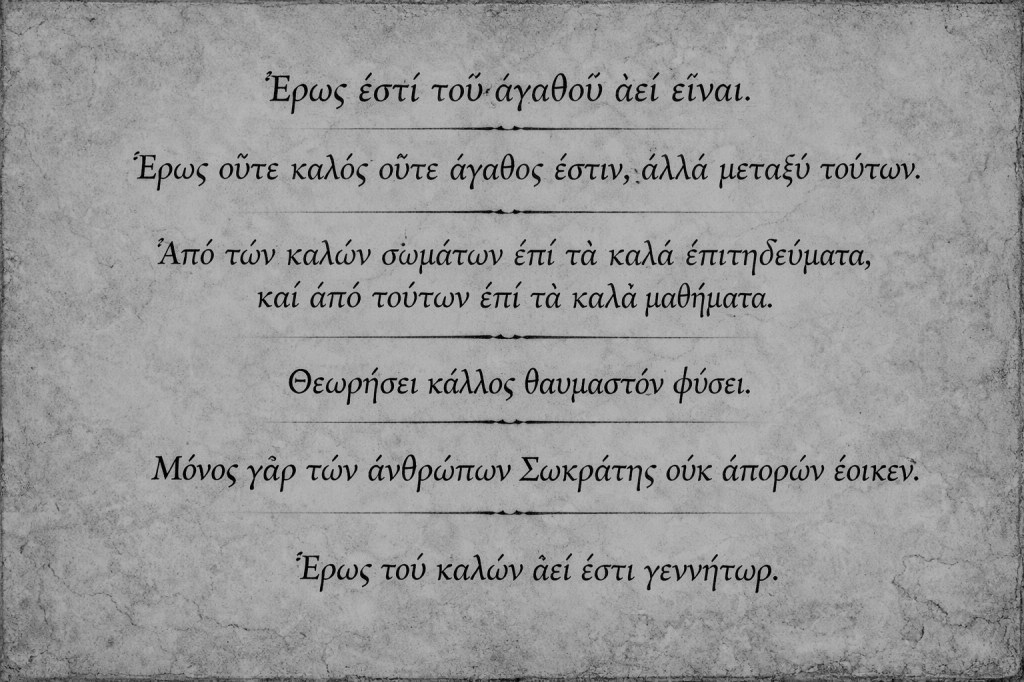
The paradox is that Symposium is not even a radical text by contemporary standards. It does not argue for rights, identities, or revolutions. It simply observes reality as it is lived: people love differently, speak differently, desire differently—and yet remain bound by a shared pursuit of meaning. If that observation is now considered dangerous, the danger lies not in the book but in the shrinking space allowed for thought.
Reading Plato today is not an act of ideological alignment. It is an act of humility. It reminds us that debates about love, identity, and inclusion are not inventions of the 21st century. They are ancient, perennial, unresolved—and that is precisely why they are worth revisiting rather than suppressing.
The Symposium ends not with certainty, but with dawn. The party dissolves. Some characters fall asleep. Socrates remains awake, still talking, still questioning. It is a quiet metaphor for philosophy itself: an endless conversation carried forward across centuries.
Banning that conversation does not stop it. It only confirms its necessity.
And perhaps that is Plato’s most enduring lesson: love and thought, like water, always find a way through the cracks.
I first encountered Plato’s Symposium in high school, and then met it again during my philosophy years at the University of Milan. It is a book I still keep on my shelves, even though reading Ancient Greek has now become difficult for me. A wonderful work in its naturalness and honesty — a book that should never be banned or pushed aside, but rather promoted and shared, so that we may still learn today what love can truly be.
Photo: dinners around the world.


 the-quiet-report.com
Leave a comment