 The Singapore Mass Rapid Transit (MRT) system is a cornerstone of the city-state’s public transport network, renowned for its efficiency, cleanliness, and extensive connectivity.
Since its inception in 1987, the MRT has grown significantly, evolving into a comprehensive system that links various parts of the island, making it one of the most effective ways to navigate this bustling metropolis.
The MRT system began with just five stations on the North South Line. Today, it spans over 200 kilometers, encompassing six lines with more than 130 stations. These lines are the North South Line, East West Line, North East Line, Circle Line, Downtown Line, and the Thomson-East Coast Line, each identified by a specific color on MRT maps. This expansion reflects Singapore’s forward-thinking urban planning and commitment to sustainable transport.
One of the remarkable features of the Singapore MRT is its integration with other forms of public and private transport. Many stations are co-located with bus interchanges and shopping facilities, providing seamless connectivity and convenience for commuters. Additionally, the system is linked with LRT (Light Rail Transit) stations in residential areas, further enhancing its reach.

The efficiency of the MRT system is notable. Trains are available at frequent intervals of about two to three minutes during peak hours, and seven to ten minutes during non-peak hours. This high frequency minimizes wait times and makes the service reliable for daily commuters. Moreover, the system uses advanced technology such as Automatic Train Control (ATC) to maximize safety and efficiency. The trains and stations are well-maintained, with cleanliness and orderliness being a hallmark of the Singapore MRT experience.
Accessibility is another key aspect of the MRT. Stations are equipped with facilities such as elevators, escalators, tactile flooring, and wide automatic gates to accommodate passengers with mobility challenges. Audio signals and visual displays are standard across all trains and stations, ensuring that information is accessible to all users, including the visually and hearing impaired.
The MRT system is not just a mode of transportation; it also plays a significant role in the country’s urban landscape. Stations are strategically located near residential, commercial, and industrial areas, facilitating efficient travel for work, education, and leisure. This accessibility has encouraged the development of vibrant communities around major MRT stations.

Financially, the system is managed through a combination of government funding and fare revenues. The fares are kept affordable through careful regulation by the Public Transport Council, which balances operational needs with public affordability. The government also invests significantly in the expansion and upgrading of the system, underlining its commitment to public transport as a public good.
Environmentally, the MRT is a sustainable transport option. It helps to reduce the city-state’s carbon footprint by cutting down on the number of cars on the road, thus lowering emissions. The government’s push towards public transport and away from private car ownership is a critical element of Singapore’s broader environmental goals.
The Singapore MRT is more than just a public transportation system; it is an integral part of the city’s identity and a crucial component of its urban development. It is an amazing social environment as well. With continual upgrades and expansions planned for the future, the MRT system is set to remain at the heart of Singapore’s vision for a connected and sustainable city.
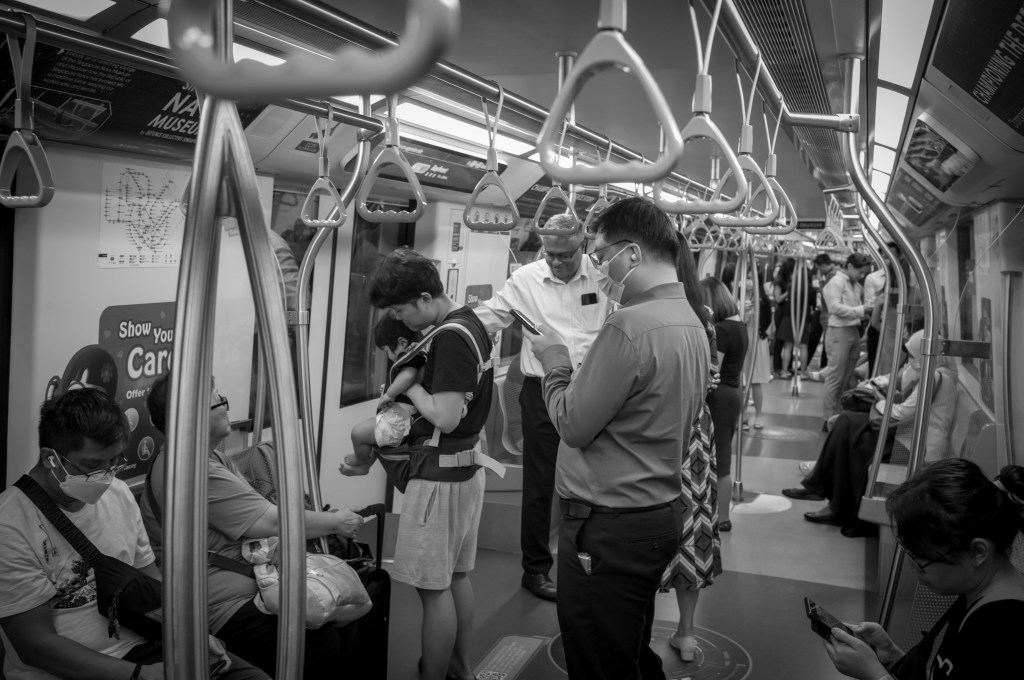
A few photos taken this morning with Leica M11 Monochrom and 35mm Summilux at f1.4.

 the-quiet-report.com
Leave a comment